Showing posts with label FARMING. Show all posts

Tuesday, May 10, 2011

Weekend Whirlwind


It was a beautiful weekend full of activity.  Saturday afternoon, Kate, Erick and I attended some Doors Open Hamilton locations - Dundurn National Historic Site - specifically the William Reid Cottage, and the Kitchen Garden, as well as the Mohawk Trail School House (but I'll save that for later!).  We would have liked to go inside the Castle but the line up extended out the door and around the corner.  We were impatient and did not want to queue. 

Sir Allan MacNab's very own cock-fighting pit. 

Dundurn, the home of Sir Allan Napier MacNab (one of Canada's first premiers), was one of my favourite historic sites to visit as a child.  Our family vacations were always educational, comprised of trips to museums, historic homes, forts, archaeological sites, natural wonders and pioneer villages, but Dundurn Castle was my hometown historical house and I am so familiar with it that I could probably give a guided tour of it myself.  My favourite part of the house as a child was upstairs with all its finery, but I am now more interested in the below stairs part of the house, with its kitchen, laundry, scullery and food stores. 

A dormant, not yet in bloom, hedge of lavender.

In recent years, there has been an exciting addition to Dundurn as they have begun to restore the Kitchen Garden, and there are plans to begin restoration on the home of the head gardener, William Reid.  The garden is a wonderful place to visit at almost any time of year, because it is always in continuous state of growth and flux. 

The garden pump.

They have been carefully recreating the garden based on historical research, and populating it with heirloom and historical plants.  Last fall when I visited the garden, I was surprised to discover that the Victorians were growing such diverse foods such as ground cherry and tomatillo. Exciting things were happening this spring.  The Victorians preferred to eat their asparagus white, and would blanch them under specially-woven baskets stuffed with straw. 


The Victorians did as much as they could to extend the growing season for fresh produce, employing cold frames and greenhouses.  They built hothouses where they grew cucumbers, peaches and pineapples indoors.  Many years ago, I remember watching a series on TVOntario, The Victorian Kitchen Garden, that documented the recreation of an English Victorian estate garden, and the astounding measures that gardeners undertook to put food on the tables of the great houses.  It was an era when a gardener could be dismissed for sending an unripe melon to the dining room!


 I am increasingly interested in historic practices of housekeeping and gardening and how these activities can contrast with contemporary approaches.  There is so much to be learned from how things were done, with such ingenuity, in days long ago. I will be posting further here, and on the Beehive, about the Kitchen Garden, and the activities below stairs at Dundurn.


From Doors Open to our very own gardening venture, up at the Buttrum farm.  It was Kate and Erick's first time up to the farm, and they plunged right in.  We worked hard for a few hours, finishing Gabby and Courtney's work planting strawberries, and then planting 150 rhubarb plants. Rhubarb and strawberries are both perennials, and will take at least a season to get established before we can begin harvesting.  Strawberry rhubarb pie and jam will have to wait a while.

Planting the tiny strawberry plants involves making a hole in the earth with your hand, tucking in the plant and gently but firmly, closing in the soil around the strawberry's roots.  This was made easy, as the soil at the Buttrum's farm is sandy, loamy and very soft, perfect for growing vegetables!


I took a few rhubarb roots home with me, where I will add them to my backyard patch.  Rhubarb roots are bizarre looking, but a very useful part of the plant.  Rhubarb leaves and roots are rich in oxalic acid, which is poisonous, but also a good mordant and dye for natural dyeing! You can also use oxalic acid to make your own cleaning solutions...


We spent Sunday at the farm planting onion sets for bunching onions, and I also finally harvested my forced rhubarb and made a lovely stewed rhubarb for Mother's day dessert, which I will post about tomorrow!

Monday, May 2, 2011

Rainy Days, Silver Linings

The mud puddle that is my vegetable garden. 


I have been so dismayed with our weather of late.  It seems every rare sunny day lands during my work week.  It has been raining so much that even when it we do have a dry day, it has been too wet to work in the garden. All this spring rain means farmers are delayed in planting their crops, and so too am I.

When I awoke this morning I was so disappointed to find it was raining again; I felt like staying in bed.   I decided to get up and go outside to check on the progress of a few things, to remind myself that despite the weather things are happening out there...


Outside on the porch, the plants I planted for the farm's new dye garden are starting to come up. This year, as part of our co-operative farming venture, we have decided to plant a dye garden.  I have my own dye garden out at my family farm, but I hardly have the chance to get out to it.  The farm garden will be a lot closer, and we'll have more hands to care for it.  

I ordered seed from Richter's Herbs and finally planted them last Sunday - and some of the plants, especially the safflower, are already quite big!  We'll have Goldenrod, Dyer's Broom, Lady's Bedstraw, Marigold, Tansy, Dahlia, Zinnia, Coreopsis,  and Weld.  We're also trying out Indigo and Woad, which yield beautiful blue dyes. I'll transplant down from my farm some Madder plants.  Madder is historically one of the most important dye plants in the world.  Madder root can produce colours ranging from orange to rust, brown to pure red.

I'll be posting more the dye garden here, and on our Beehive blog, all summer. 


Last Saturday, I direct sowed some vegetable seed in the garden:  lettuce, spinach, arugula, mâche, beets, turnips and radishes.  It has rained so much this week I was worried that maybe my seeds would be washed away, but here they are, tiny arugula and turnip leaves.

The wire you see over top of the seed bed is to protect my vegetable from the rabbit who has been visiting my yard all winter.  Last year he ate all my bean plants!


Under the cold frame, my eggplant and tomato plants are suffering a little from lack of sun, but the forget-me-nots in the frame are pretty content.

Asparagus spears are poking up their heads as well.


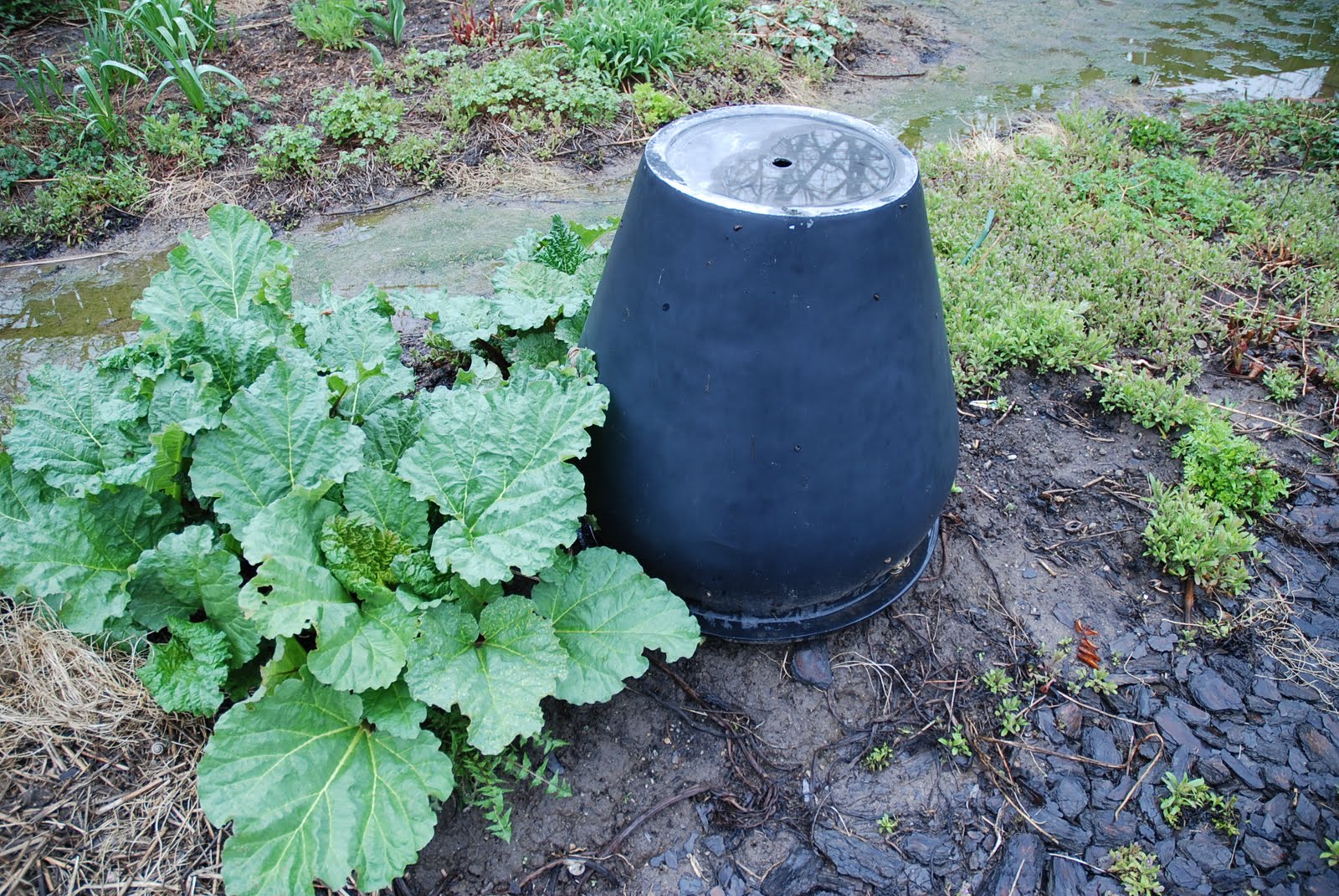
My rhubarb is pretty happy with this cool, wet weather.  So there are many things to be cheerful for.  But perhaps most exciting of all is what grows hidden beneath this large upturned planter.


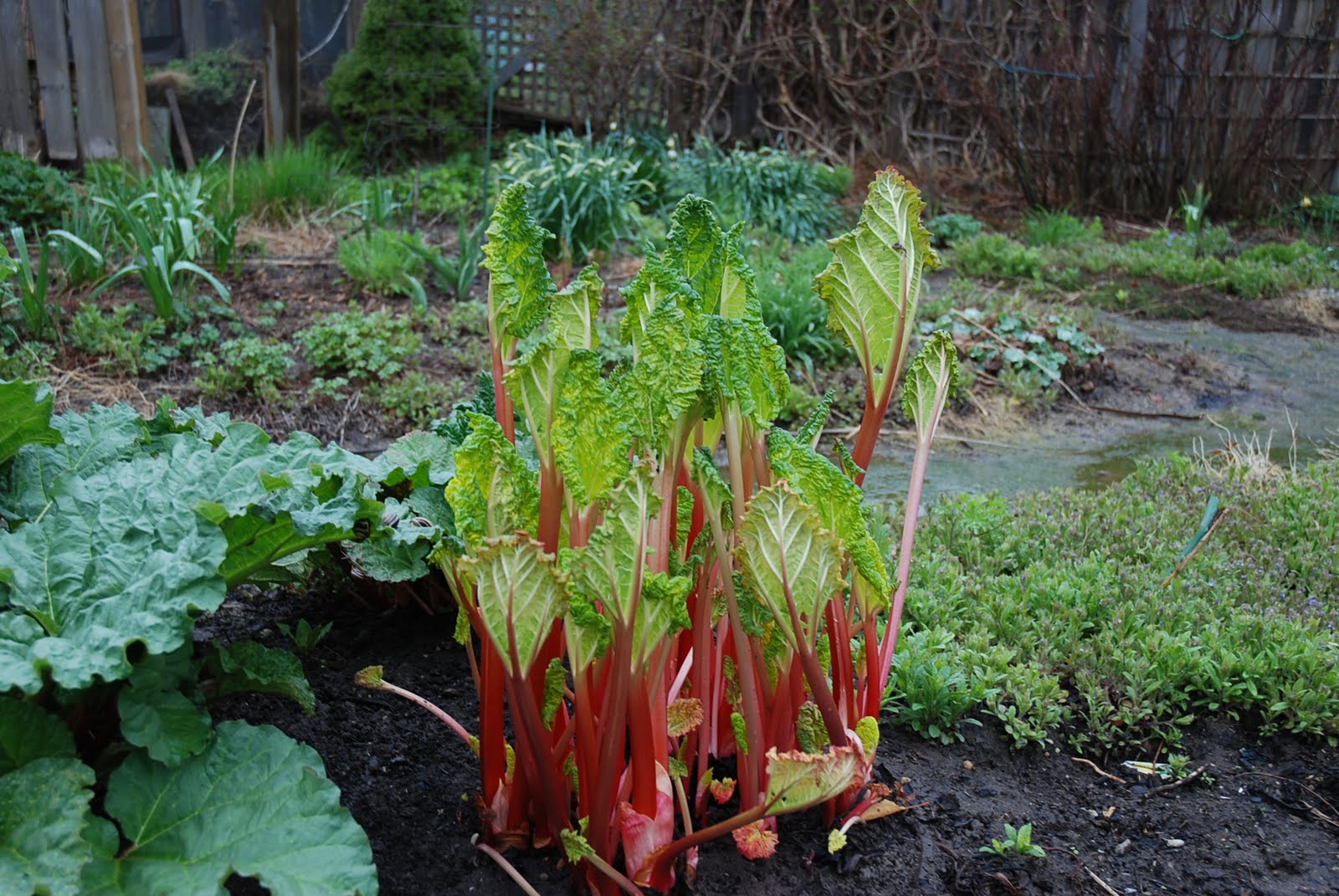
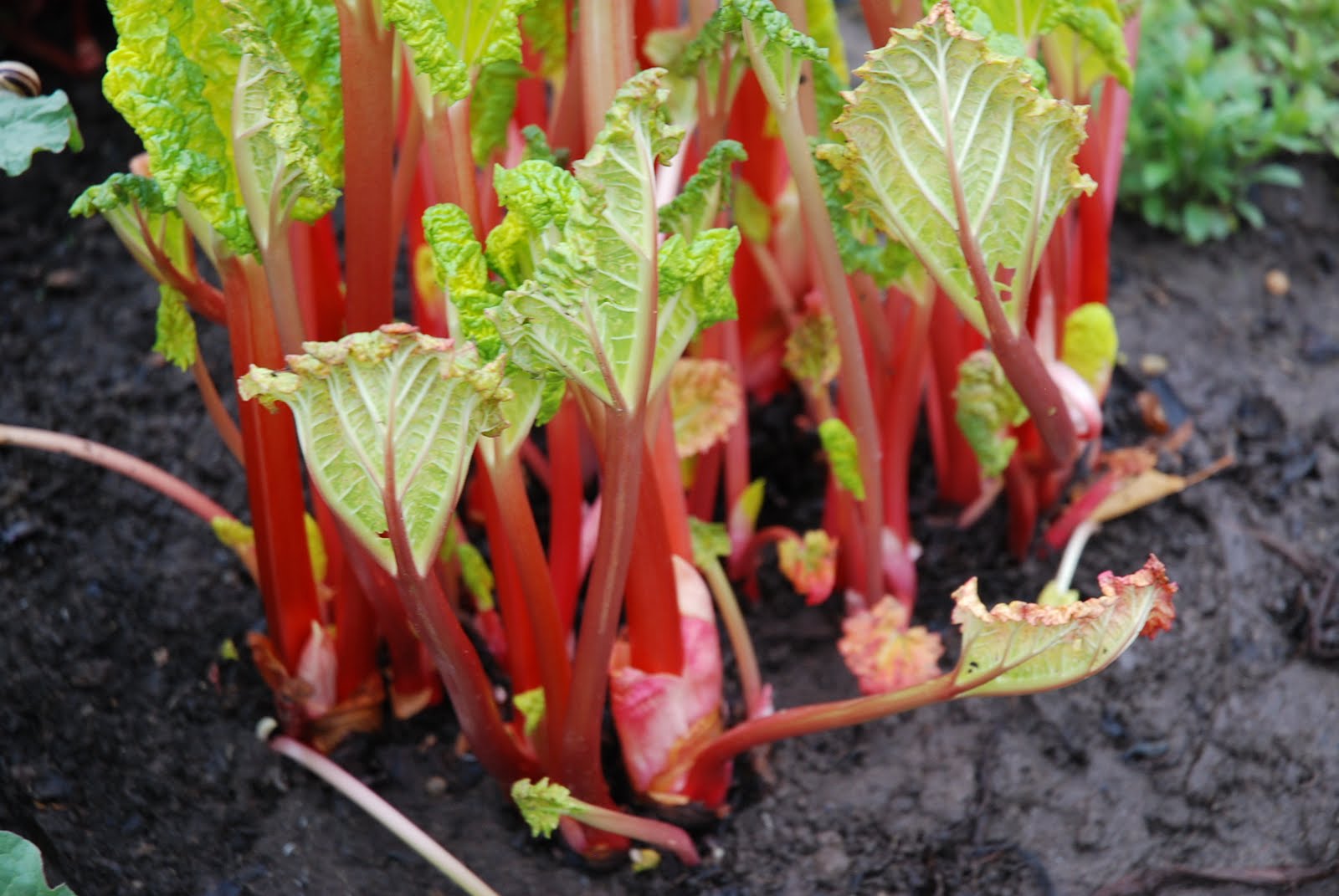
Several weeks ago, when the rhubarb was just beginning to come up, I put this large black fibreglass pot overtop of the emerging shoots. Traditional rhubarb forcing pots are made of terracotta, but any large pot will do - this one is very large, about 24 inches tall, by 18 inches in diameter.  The small hole in the bottom of the pot allows a little light inside, and the pot creates a warm little house to bring the rhubarb on more quickly.  The stalks will reach toward the light, growing tall and straight, keeping the whole stalk bright red.


 Is it not just beautiful?  I'll pull some of this lovely rhubarb soon.  The rain has stopped, the sky is brightening, and the birds are chirping. It's election day, and it's time to go vote!

There are some creatures who love this wet weather!

Tuesday, March 29, 2011

Spring Forward.

Eggplants with their seed leaves.

In winter, I hibernate. Hence the long silence from yours truly.  In spring, my energy returns, and so does my enthusiasm for things domestic. Last week, it snowed.  Nevertheless, now is the time when I begin to plan for outdoor activities later in the spring.  Namely, beginning the garden, which starts with seeds.

Back in February, I made a trip to Tregunno Seed Co. on Catherine Street North to pick up potting soil and pots. I ordered my tomato and eggplant seeds online, from The Cottage Gardener and The Cook's Garden.  The Cottage Gardener is a family owned nursery near Port Hope, Ontario, that specialises in rare heirloom varieties of tomato.  They have a vast selection of tomatoes, but also grow many other heritage and unusual varieties of other vegetables. The Cook's Garden is an American seed company.  They have a few varieties of tomato and eggplant that I like and have not found anywhere else.

Seed Packets.

Every year, I like to try a few new varieties of tomato, along with my favourites.  I love tomatoes, and in summer time, I eat several tomatoes everyday.  I also like to can whole and stewed tomatoes to eat plain and to cook with - San Marzano.  Last year I also grew a variety called Principe Borghese, an Italian variety grown for sun-drying.  These are repeat for this year. My ultimate standby is the powerhouse tomato Brandywine, a huge, beautiful, flavourful red fruit. Wonderful for eating fresh, cooking and preserving.

This year, I may have slightly lost my mind as I decided to grow 11 different varieties.  2 varieties will be for preserving - canning and drying.  The rest will be for eating fresh, and canning as well.

This season's other players are a multi-hued cast ranging from white (White Queen)  to yellow-orange (Jaune Flammee, Nebraska Wedding and Valencia), to multi-coloured (Big Rainbow), to red (Rose de Berne and Bloody Butcher) to purple (Black Krim).

Seeds are amazing.  An enormous tomato plant will grow from each of these dry little seeds!

 Once I have the seeds planted (3-5 seeds per pot), I water them, and place them inside these plastic domes in a sunny window until they have germinated.  Once the plants start coming up, I will begin rotating the trays - the plants seek sunlight, so will lean toward the light -  unless rotated daily, you will have spindly, crooked plants! Once the plants are about 1-2 cm tall I remove the domes.  If the weather is warm, I will put the dome-covered trays outside.  In the sun, the trays become like mini greenhouses.

Tomatoes toasty and warm in their little greenhouses.

Three weeks ago, I planted 5 varieties of eggplants, and I now have little seedlings.  Soon, they will need thinning, but I am waiting until they start to get their second leaves. As soon as the snow melts, I will begin putting them outside in the cold frame during the day.

My darling eggplants. Are they not adorable?

After danger of frost, I will plant my babies out in the garden -by my Grandma Blanche's rule of thumb - after the May 24th holiday, or when the black walnut trees begin to leaf.